Grant Strategy: Turning Non-Dilutive Capital into Business Growth
Why the strongest grant opportunities begin with project readiness, financial discipline, and a broader capital strategy
Government grants can reduce the cost of growth, strengthen a project's capital structure, and help qualified businesses advance investments that may be difficult to finance through traditional sources alone. But a grant is not a financing strategy by itself. Its value depends on how well the opportunity fits the business, the readiness of the underlying project, and the company's ability to execute and comply after an award.
The opportunity - and the discipline it requires
Federal, state, and regional programs can provide non-dilutive capital for expansion, modernization, job creation, infrastructure, energy, agriculture, workforce development, and technology investment. For lower middle-market, private, and family-owned businesses, that capital can be meaningful: it may reduce the amount of debt or equity required, improve project-level returns, and make a strategically important investment more viable.
Yet identifying an available program is only the beginning. Grant programs are competitive, funding is never guaranteed, and an award often brings matching-fund, reimbursement, reporting, procurement, and performance obligations. Management must determine whether the potential benefit justifies the time, cost, and organizational resources required to pursue and administer it.
That is why grant strategy should start with a business decision, not an application. The central question is not simply, “Can we apply?” It is, “Does this opportunity advance a project we are prepared and committed to execute?”

What makes a grant-supported project competitive?
Program objectives and scoring criteria vary, but strong projects tend to share five characteristics.
- A clear strategic purpose. The project addresses a defined business need and supports the company's long-term growth plan.
- Direct alignment with the program. The proposed investment advances the outcomes the funding agency is trying to achieve, such as job creation, domestic manufacturing, rural development, emissions reduction, supply-chain resilience, or workforce training.
- Measurable results. The application translates the project into credible outcomes - capital invested, jobs created or retained, production added, energy saved, emissions reduced, or benefits delivered to a community or region.
- Financial and organizational capacity. The applicant demonstrates that it can fund the entire project, satisfy matching requirements, and provide the leadership, technical resources, and internal controls necessary to complete the work.
- Project readiness. Scope, site control, engineering, permitting, environmental review, vendors, schedule, and financing are sufficiently advanced to support a credible implementation plan.
Grant writing is one step in a larger process
A compelling narrative matters, but it cannot compensate for an underdeveloped project. The most effective grant strategies move through a disciplined sequence.
- Assess the opportunity: Evaluate eligibility, strategic fit, funding availability, competitiveness, timing, matching requirements, administrative burden, and potential value. The goal is to concentrate resources on opportunities with the strongest fit - not to pursue funding simply because it exists.
- Test readiness: Review project definition, financial capacity, site control, permitting, environmental considerations, technical resources, staffing, procurement, schedule, and compliance capabilities. If material gaps exist, strengthen the project before committing to an application
- Develop the project and capital plan: Establish scope, objectives, budget, sources and uses, timeline, performance measures, responsibilities, risks, and financing. These elements should remain consistent across the narrative, financial model, and supporting documentation
- Build and coordinate the application: Connect the proposed investment to the program's objectives, assemble the required financial and technical support, and coordinate input from management, engineers, accountants, attorneys, lenders, and other partners.
- Prepare for review and award: Anticipate agency questions, contracting conditions, evidence of matching funds, revised budgets, reimbursement procedures, and internal implementation responsibilities.
- Administer the award: Track eligible costs, reimbursements, milestones, performance, procurement, records, and reporting. A successful award is not complete until the project is delivered and the recipient's obligations are satisfied.

The capital stack matters
Many grants require matching funds, and many are paid on a reimbursement basis. A business may therefore need enough liquidity or interim financing to pay eligible costs before grant proceeds are received. Even a substantial award can fall short of its intended value if the remaining capital is not available at the right time or on workable terms.
Grant funding should be evaluated alongside company equity, retained earnings, commercial bank financing, private credit, government-backed loans, equipment financing, tax incentives, and other public funding sources. Considering these sources together helps management determine the project's true economics, understand funding dependencies, and build a credible path from award to completion.
Key insight: The objective is not merely to secure an award. It is to structure and execute a financially viable project that advances the company's long-term goals.

Winning the award is the midpoint, not the finish line
An award may require additional documentation, finalized budgets, confirmed financing, or a formal grant agreement before funding begins. Once underway, the recipient may be responsible for reimbursement requests, expense support, procurement records, milestone tracking, performance measurement, and audit-ready recordkeeping.
Weak administration can delay reimbursement, restrict the use of funds, place the award at risk, or result in repayment obligations. Before the project begins, management should establish clear ownership for expense approval, document collection, reporting, agency communication, and performance tracking.
Businesses pursuing multiple programs should also manage grants as a portfolio. A coordinated view of deadlines, project dependencies, matching requirements, financing commitments, award conditions, and reporting obligations helps leaders sequence projects and avoid overextending internal capacity.

Avalon Growth Capital's approach
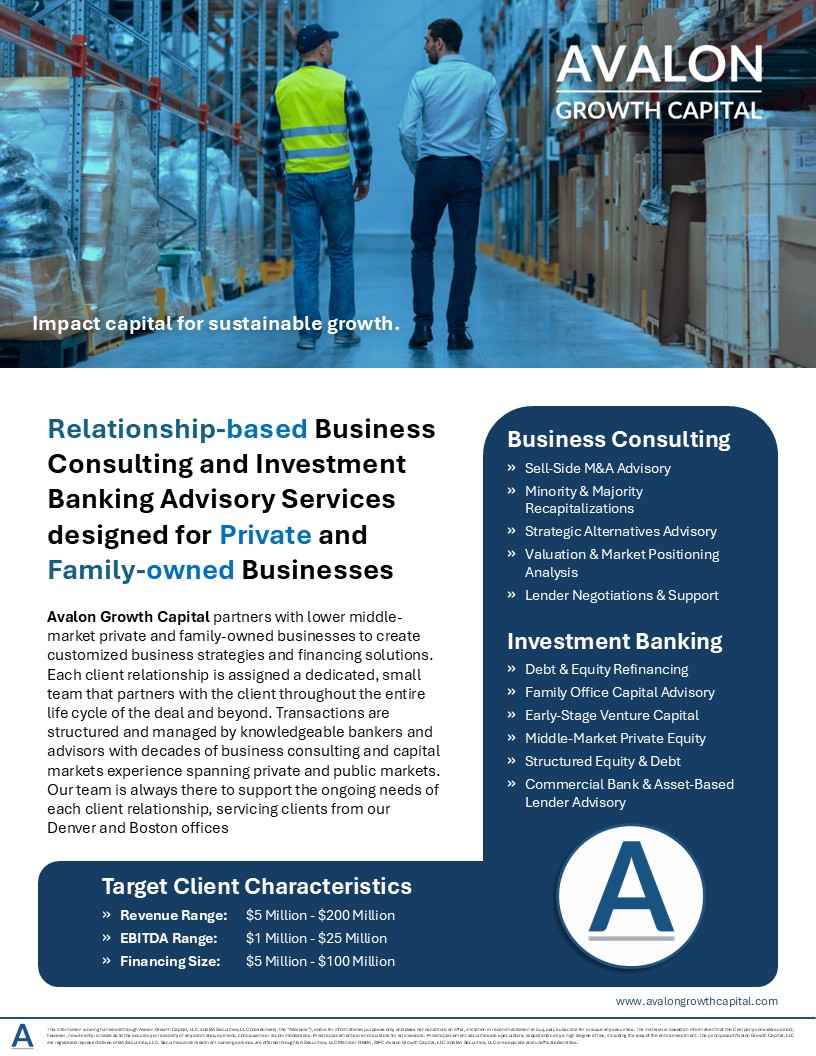
Avalon Growth Capital helps lower middle-market, private, and family-owned businesses evaluate government funding opportunities as part of a broader growth and capital strategy. We begin by understanding the company's project pipeline, funding priorities, and long-term objectives. We then assess which programs are strategically aligned, whether the organization is prepared to compete, and how grant funding can fit within a complete financing plan.
Our work can span opportunity assessment, grant readiness, project development, application coordination, financial materials, matching-capital strategy, award contracting, administration, portfolio management, and special situations where delays or compliance issues may place an award at risk.
This integrated approach is designed to transform qualified projects into competitive applications - and grant awards into measurable business outcomes.
A practical starting point
Before pursuing a grant, management should be able to answer four questions:
- Is this a project the company intends to pursue even if the grant is not awarded?
- Can the company finance the full project and manage the timing of reimbursements?
- Are the scope, schedule, budget, outcomes, and implementation responsibilities sufficiently developed?
- Does the organization have the capacity to meet the award's reporting and compliance obligations?
If the answers are clear, grant funding may become a powerful component of the company's growth strategy. If they are not, the highest-value next step may be to strengthen the project before pursuing an application.
* This article is provided for educational and informational purposes only and does not constitute investment, legal, tax, or financial advice. Each financing or investment opportunity should be evaluated based on its specific facts, risks, structure, and objectives.
Recommended for you
Grant Strategy: Turning Non-Dilutive Capital into Business Growth

Private Credit and Lender Finance: Understanding the Modern Lending Ecosystem
Avalon Growth Capital Shares Insights For Sourcing Mission-focused Deal Flow in Rural America
We are driven by a passion to transform the world by empowering visionary entrepreneurs who dare to challenge and redefine today’s standards.

Partner with us
Let’s talk about the future growth of your business
Partner with usConnect with us to discover how our customized business consulting and investment banking advisory services can benefit your business.
.svg)